Whoop vs Garmin: Winners and Losers After 6 Months of Wearing Both
I wore Whoop and Garmin for 6 months. Here’s how they compare for sleep, HR accuracy, AI, recovery, steps, calories, wearability, and everyday use.

After six months wearing both Whoop and a Garmin Fenix, I’ve changed my mind on several things. Here’s my real-world Whoop vs Garmin comparison across sleep, recovery, heart-rate accuracy, AI, calories, steps, and everyday usefulness.
If you're new here, check out my other articles on similar topics:
What My Garmin Told Me About US Navy Flight Training
Everyday Use
Winner: Garmin
I've gone back to wearing my Garmin Fenix, and, honestly, it feels so good to have it back on the wrist.
I don't like wearing something on my working / dominant hand so, for me, it's kind of been a matter Whoop or Garmin. I'm still using (begrudgingly) the Whoop with the bicep band but the reasons for the Garmin being back in the number one spot on my left wrist is its insane utility. Here are just five:
- TIME.
- Torch - incredibly useful for navigating with the red light at night or the white light if you don't have your phone handy.
- Timer - I missed this so much with the "dumb" aspect of the Whoop.
- Garmin Pay - unmatched convenience.
- Date, step count, weather, and HR.
The biggest "pro" people say about Whoop is the fact that it is distaction-free and screenless. In my experience, this is kind of also the biggest "con". Whoop makes you so dependent on your phone, which I talk about in the "Least Distracting" section.
Activity and Sleep Editing
Massive Winner: Whoop
The retroactive timestamp editing is one of the things Whoop does so well that it makes the experience feel almost magical. First, you don't ever need to start an activity because you can always timestamp the period after the fact.
But you probably won't have to.
Whoop's software is so good at identifying activities and autodetecting the start/stop point, every time I workout with it I'm shocked with how the beginning and end times match what I manually recorded with my Garmin.
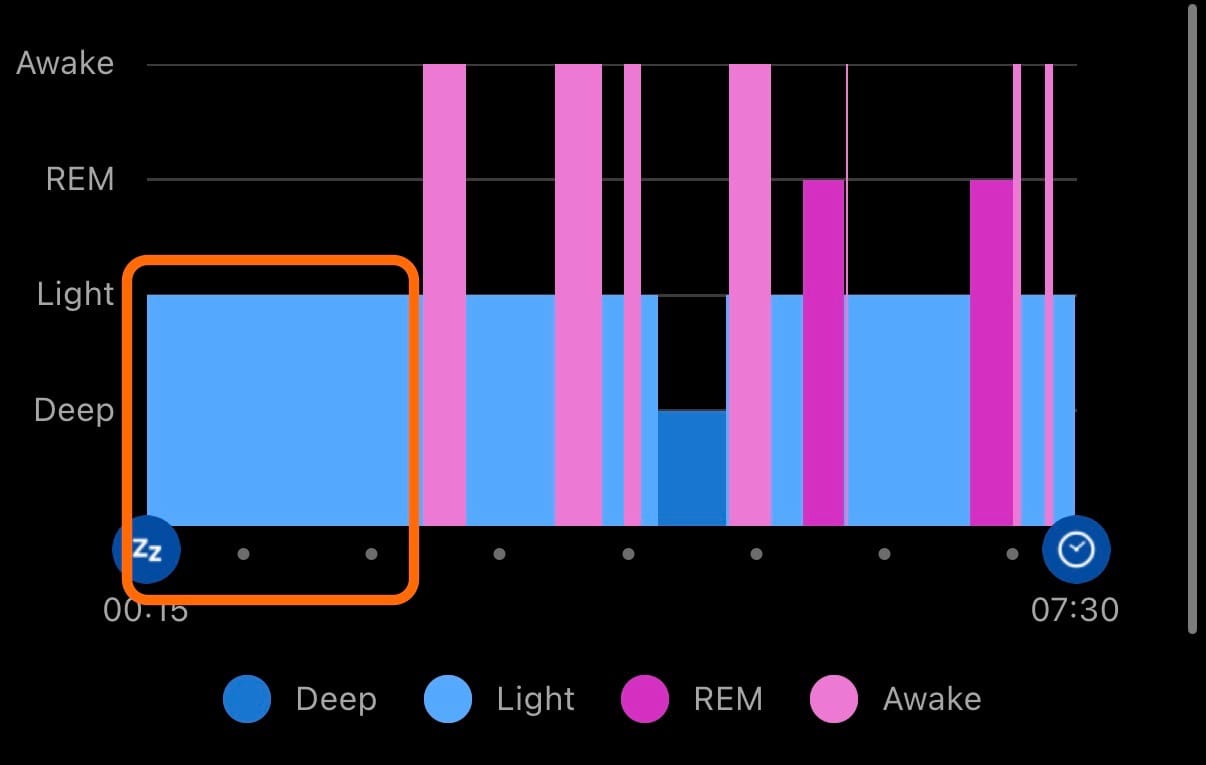
And this accuracy extends to sleep! Sometimes (although not often) Whoop miscalculates when I actually fell asleep. But since it's always collecting high quality HR data, I can simply go back and scrub to the correct start point and the software will automatically recalculate the entire sleep period, updating stages and HRV accordingly.
GARMIN!! WHY CAN'T YOU DO THIS!?!
Garmin simply adds a block of light sleep.
Why.
Whoop Coach vs Garmin AI
Winner: Bevel (Wait That's Cheating!?!)
To be clear: I use the Garmin Connect app as little as I have to and I have never paid for the premium version that provides AI coaching and, unless something dramatically changes, I never will. The app is ugly, difficult to navigate, and unintuitive to understand readiness in a simple way. And and I say this from someone who has used the ecosystem for eight years.
Whoop's AI sucks. So bad. There's example after example on Reddit where people post their experience with the AI being unable to reference its own database of information.
- WHOOP Coach pulls the wrong historical workout data A user did a 15-minute treadmill session and one hour of strength training, but Coach referenced an old 22-minute cardio workout and a two-hour strength workout from the prior month. The user explicitly says WHOOP was “pulling incorrect historical data and assigning it to current workouts.”
- WHOOP Coach confidently reports completely wrong current data In a September 2026 post, the user's actual Recovery was 59% Yellow, while WHOOP's AI told them it was 96% Green. The same user also reports Coach losing conversational context and responding to a request to repeat its previous answer with unrelated information.
- WHOOP Coach can't reliably query historical data and may hallucinate it A Whoop user reported that Coach invented strain, steps, and HRV data that didn’t exist in their account, then acknowledged it had hallucinated those metrics when challenged.
Bevel, while not perfect, I find to be very impressive. And although there are some similar Reddit posts complaining about Bevel's AI, I haven't experienced the same degree of issues and Bevel's team is always responding, trying to fix the issue. So that I like.
A great example of the uselessness of Whoop's AI is below.
With the prompt of:
Compare my three most recent Alpe Du Zwift rides and why my most recent one went the best?
Bevel analyzed multiple attempts and concluded it was due to:
- Superior Power-to-HR Efficiency
- Recovery
- Pacing
Whoop's answer: "I don't have those Zwift files in front of me, but if you paste the screenshots I can break down what changed".
Whoop's AI is a prime example of the AI slop that instantly turns me into a technology-hating old man.
Least Distracting
Winner: It's complicated
This is where I caught myself finally not just going with conventional wisdom and thinking for myself a bit on what works for me.
One of the main reasons Whoop is so popular is due to its screenless, distraction-free design. No buzzing, no messages, not even the TIME.
Some people love this. I don't. I realize if something is going to be on my body 24/7 it better be useful or inconspicuous. Whoop is like kind of both and also kind of not both.
With Whoop, you have to constantly check your phone to tune in to the data its collecting and if you want to use the Strength Trainer app correctly, the amount of phone involvement during a workout is beyond annoying. You're basically on your phone the entire time for starting sets, stopping sets, and checking your rest time.
Garmin, on the other hand (pardon the pun), is far more phone-free and less distracting. I turn off all notifications, load music onto it with Spotify, and enjoy hours in the gym or on a run, completely forgetting I own a phone.
To me, that's truly distraction-free, and why I think Garmin is the winner here.
Stress Measuring
Winner: Whoop
Is it useful? Idk, I'm definitely not sold quite yet.
All I know is Whoop's way of measuring and displaying "stress" is more intuitive than Garmin's and more accurate than Bevel's if you don't own an Apple Watch. Bevel doesn't get HRV from Garmin during the day so that crucial metric is omitted in their stress calculation.
Heart Rate Accuracy
Winner: TIE
If I was writing this a month ago I would have said Garmin, hands down. But with Whoop's most recent firmware update, their HR accuracy during things like weightlifting has improved dramatically.
To the point where Whoop's HR accuracy is on par and perhaps even better than Garmin's?!! In any case, it is negligible as both lag / vary when measured against an ECG chest strap.
But, again, if you do believe in the importance of logging weightlifting activities with Whoop's tedious Strength Trainer app, utilizing Whoop's advanced accelerometer algorithm to more accurately estimate an ambiguous Strain score, Whoop has made tremendous progress here, HR-wise. I don't.
Comfort and Wearability
Winner: Garmin
The biggest thing I've been struggling with since getting a Whoop is feeling like it requires a lot of mental attention. I, in no way, find it something I put on and never takeoff or relocate on my body.
For example, how I use various bands in one day:
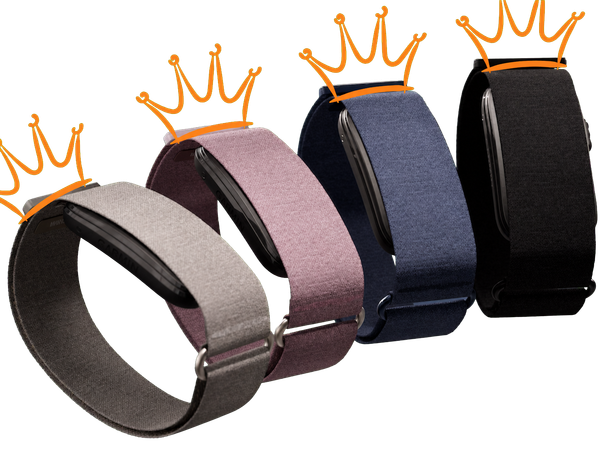
- SuperKnit is best for sleeping but I find it gets loose and slides around during sweaty workouts.
- SportFlex is perfect for workouts but can be somewhat irritating to the skin when worn constantly and isn't as comfortable at night.
- Bicep band is best for HR accuracy or if I want to conceal that I'm wearing a Whoop but suffers from step count inaccuracy, isn't so comfortable to sleep with, and takes forever to dry.
Garmin is purely "set it and forget it". I wear it 24/7 and it's the 90% solution for all of my needs. The only downside is that if I want to wear a mechanical watch for formal occasions, I lose data tracking.
The point when I start worrying about tracking the caloric expenditure or Strain of my horrible dancing at a wedding will be the point when I should probably sell all of my worldly devices and move to Tibet to pursue inner peace.
Whoop Steps and Calories Accuracy?
Loser: Whoop
I decided to group these together because it's the same criticism for both.
Two of the most common complaints on Reddit about Whoop are: steps being off and calories being comically off.
And the response that gets posted every. single. time?
"Don't worry about it, no tracker is perfect."
Guys, that's not the point. We're not looking for perfection from Whoop. The argument that it's difficult to calculate calories accurately from a wrist-based piece of plastic is fair... and also not at all. They have an entire research laboratory full of doctors studying these things and, besides, typical caloric expenditures have been studied for decades and are pretty well-known.
Because the biggest complaint isn't that Whoop is 10% high or 10% low, it's that you can go a normal day with moderate activity and a normal workout and Whoop will tell you you burned less than your Basal Metabolic Rate.
That's not a matter of accuracy, that's a matter of "what the hell is the value in this device?"
If it took my BMR calories and added 100, 500, and 1,000 calories simply based on whether the workout was 20 minutes, 45 minutes, or 90, it would be ten times more accurate than whatever it currently does.
And the same goes for steps. Originally Whoop's stance was steps aren't relevant. Okay, fine. I agree!
Then they decided to implement step tracking. Okay, fine. I still don't care.
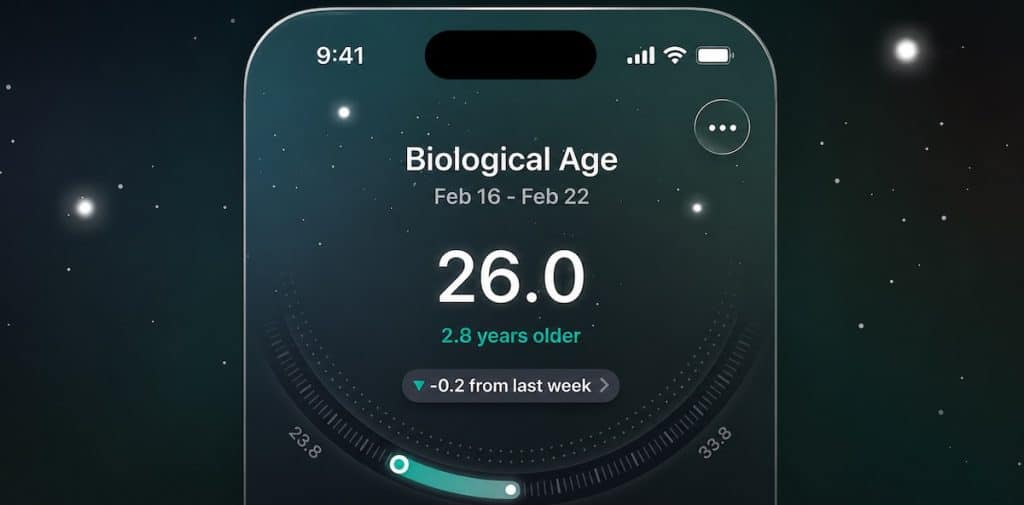
THEN they decided steps were actually so important that they are a key metric in determining your Whoop Age.
FINE.
Except, not... because Whoop, whether worn on the wrist or bicep, cannot come remotely close to accurately measuring step count. I've tested it dozens of times, comparing it to Garmin, iPhone, and physically counting myself.
It's never within 15%, and that's being generous.
Goods, bads, and others. No device is perfect and all have their strengths. I'll probably continue to wear a combination of all for now and I'll probably continue to change my mind on things as well!
Let me know what you think.
-Will
Heads up: this post contains referral and affiliate links, including Amazon Associates links. If you sign up or buy through them, I may earn a commission or membership credit at no extra cost to you. As an Amazon Associate I earn from qualifying purchases. Nobody sponsors The Flyby — I bought everything reviewed here.
Your Support
I write everything for free in the hopes that it will inspire and educate on what it’s like to fly planes in the world’s greatest Navy and to spread the joys of aviation in general. I don't run ads and I don't put anything behind a paywall.
If you enjoyed this article, you can show your support by checking out my store on Etsy, where I sell really cool aviation-themed streetwear clothing. It’s all designed by me, a real-life, very-average fighter pilot.

Also, if you're interested in Whoop and how it can help in your fitness journey, you can try a one month free trial. I'm not sponsored but it does help me to continue to write on topics and tech that help pilots and fitness enthusiasts.
Or, if you think you'd prefer to give Bevel Health (my favorite app to use with my Garmin Fenix) a go, you can also try one month free.
And finally, if you are interested in the best fitness watch on the planet, worn by thousands of pilots worldwide, check out Garmin. I'm not sponsored, they just make one hell of a product. If you shop through my Amazon affiliate link, I make a small commission at no cost to you. It's not quite enough to pay for weekend gas in the Cessna, but it does help cover a couple of beers. Thank you!
Let me know if you decide to try any of them out and what your thoughts are! I love talking tech.
-Will!