Navy OCS Workouts and How to Prepare for the PRT
How hard are the workouts and will you survive?

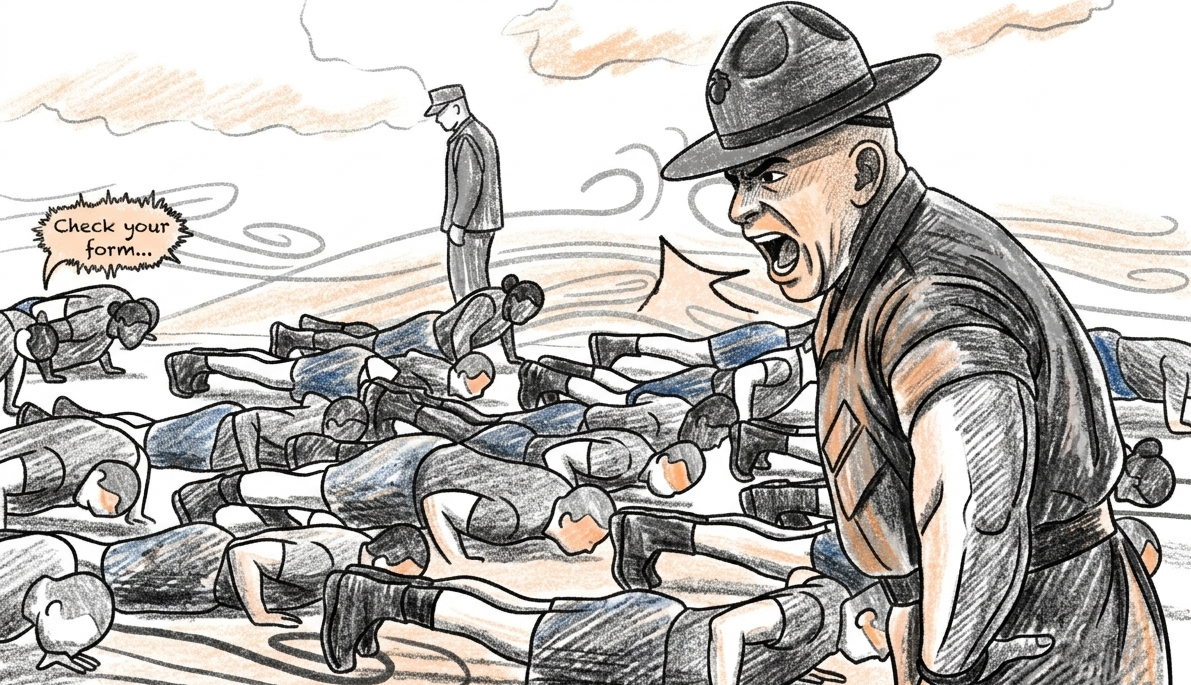
If you’ve ever wondered what the workouts at Navy OCS are like or how to prepare for the Physical Readiness Test (PRT), this is the post for you. The workouts are nothing crazy and if you can already meet “Excellent Low” standards for the PRT then you have nothing to worry about but I will include some workouts at the end of this that helped me improve my scores significantly.
At this point, you’re probably wishing I’d write about anything other than OCS and wonder why it’s the only topic I’ve covered so far. The truth is, similar to Lindsay Lohan’s decline since Mean Girls, I peaked as a CandiO yelling at Indocs on their first day. Since that day, I’ve been scrapping for any sort of authority I can find as an Ensign, which often materializes in the form of critiquing ROTC grads in my head on their messy gig lines and lack of shirt stays.
This post contains affiliate links. As an Amazon Associate, I earn from qualifying purchases at no extra cost to you. I only recommend gear I’d actually use.
What Is the Navy PRT?
Before getting into OCS-specific prep, it helps to know what you’re training for. The Navy Physical Readiness Test (PRT) consists of three events: push-ups, the forearm plank, and a 1.5-mile run (or an approved cardio alternative like the Concept 2 rower, stationary bike, or 500-yard swim). All advice can therefore be boiled down to: you need to be able to run and do bodyweight calisthenics. Being lean helps tremendously with both of these.
Note: the Navy replaced curl-ups/sit-ups with the forearm plank in 2021, so if you find older prep guides still referencing sit-ups, they’re out of date.
Training Schedule at OCS
You will consistently PT five days a week in addition to any rifle drill or other random events. The exception would be if you were scheduled for the swim qualification or the fire trainer, which are considered high-risk activities and necessitate the day free of morning PT.
PT occurs from around 0530 to 0630 but you‘ll be on the field (or in the hallways of Nimitz) by 0515 and in formation by 0520. The workout usually lasts around 30 to 45 minutes and is sandwiched by a really effective warm-up and cool-down that never gets old.
OCS Workouts
Three days a week, on average, you will do a HIIT (high-intensity interval training) calisthenics workout of roughly five rounds of five different exercises for 45 seconds with a 45-second water break between each round. Sometimes it will be just a core HIIT focusing on improving your plank time but usually, it will be a full-body workout of squats, jumping jacks, push-ups, and core, with variations of each.
Roughly twice a week you will be doing group runs. The runs can vary from a sustained endurance on the track to a “train run” where you run with a group in two side-by-side lines and sprint from the back to the front where you’ll jog again until you become the last in line and sprint again. They do a good job of creating three different speed groups so that you can run at a speed that will push you but isn’t too fast. I’d recommend going in the fastest group you can tolerate so that you get faster on the PRT but just don’t be like the person that was in my class that joined the fastest group and then was crying after 3 minutes. That was confusing.
Additionally, they may combine running and calisthenics so that you’re running the road loop and stopping every 200m to do body-weight exercises in the goose poop. I suppose in this situation it would be wise to join the fastest group and use your tears to wash the poop off.
OCS Preparation
If you’re worried about not being up to standards when you get to OCS: start now. There were way too many people when I was there that would somehow break their legs or get severe shin splints from the running that we did. It topped out at maybe eight miles per week. Put some miles on your shoes and avoid getting rolled for preventable reasons.
WEAR GOOD SHOES. You’re going to run more at OCS maybe than you ever have in your life. Invest in a quality pair of shoes. Your runners will be inspected when you show up and if they’re too worn-out you’ll be forced to buy whatever the NEX is selling. Don’t wait.
Did I just casually include myself in a list of the most famous and accomplished run-fluencers?
No comment.
Push-Ups
Do push-ups at least three times a week. It’s a simple body-weight exercise so it won’t leave you too sore and it can be done in ten minutes. Create HIIT routines like you’ll see at OCS, an example could look like this (adjust as needed):
5 ROUNDS FOR TIME:
- Regular push-up (30 sec)
- Shoulder taps (30 sec)
- Wide grip push-up (30 sec)
- Side star plank (30 sec)
- Hand-release push-up (30 sec)
- 1 MINUTE REST
Core
My plank time when I first got to OCS was around 2:30 and by the second PRT I was maxing it out. This can be done simply by doing the same HIIT-style workout. An example could be:
5 ROUNDS FOR TIME:
- Mason twist (45 sec)
- V-ups (45 sec)
- Bicycle kicks (45 sec)
- Crunches (45 sec)
- Supermans (45 sec)
- 1 MINUTE REST
Gen-Z Healthmaxxing tip of the day: do a couple of sets of max push-ups or planks after completing your core workout. It was the most difficult time to perform those max-effort exercises which, consequently, made them easier when you were fresh.
Running
Probably the most neglected training aspect of the PRT. For some reason people hate running and then worry about whether they'll pass or not. Make your life easy and just learn to run before going to OCS—you’ll get injured less, all the workouts will be easier, and you won’t have to stress any of the fitness tests. Don’t focus exclusively on distance. Leading up to OCS, twice a week you should run speed intervals, and once a week you should run distance (three or four miles) at a steady pace.
Gen-Z Healthmaxxing tip of the day: Audiobooks. I have recently discovered audiobooks (I know, I’m late) and listening to these has been a game-changer for slogging through running and other types of cardio I hate doing. Sapiens was incredible.
Examples below:
SPEED INTERVALS, REST 90sec BETWEEN EACH SPRINT (total about two miles):
400m x 4
Rest 5 minutes before moving on
200m x 4
Rest 3 minutes before moving on
100m x 4
Rest 2 minutes before moving on
SPEED INTERVALS, REST 2 MIN BETWEEN EACH SPRINT (total two miles):
- 800m x 4
Let me know if you have any questions and good luck!