Navy vs. Air Force Fighter Jets: What’s the Real Difference?

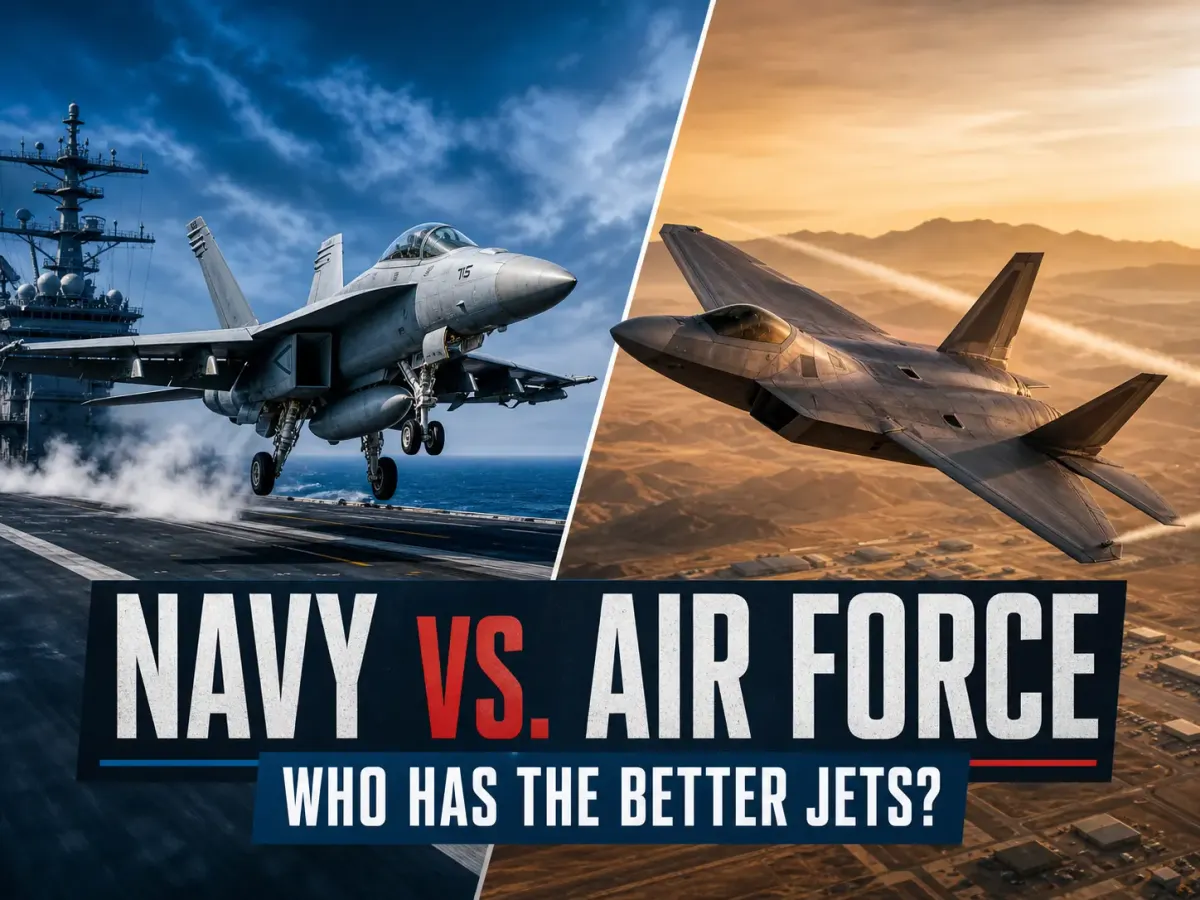
If you compare Navy vs. Air Force fighter jets by asking which branch has the “better” airplanes, you are starting with the wrong question.
The Navy and Air Force buy and operate aircraft for different environments. Air Force fighters launch from established runways with support from a massive land-based network. Navy fighters must bring combat power from the sea, survive life aboard an aircraft carrier, and launch and recover from a moving flight deck.
That single difference shapes almost everything: aircraft design, range, landing gear, training, tactics, and even how pilots think about fuel.
Navy vs. Air Force Jets: The Short Answer
The Air Force has the broader and more specialized combat-aircraft inventory. It operates dedicated air-superiority fighters, multirole fighters, attack aircraft, bombers, tankers, and long-range support aircraft.
The Navy operates a smaller tactical-aircraft mix built around the carrier air wing. Its jets have to be rugged, compact, versatile, and capable of operating hundreds of miles from a conventional runway.
| Category | U.S. Navy | U.S. Air Force |
|---|---|---|
| Primary operating base | Aircraft carriers and naval air stations | Land-based airfields |
| Main tactical fighters | F/A-18E/F Super Hornet and F-35C | F-15, F-16, F-22 and F-35A |
| Specialized advantage | Mobile sea-based airpower | Scale, range and specialized aircraft |
| Landing environment | Short, moving carrier deck | Long, fixed runway |
| Typical design priorities | Durability, low-speed handling and carrier suitability | Performance, range, payload and mission specialization |
| “Who has better jets?” | Better for carrier warfare | Better for large-scale land-based airpower |
The honest answer is that neither branch has universally better jets. Each has aircraft optimized for the war it expects to fight.
Why Navy Fighter Jets Are Different
A Navy fighter is not simply an Air Force fighter painted gray.
Carrier suitability affects the entire aircraft. Navy jets need reinforced landing gear and structure to absorb arrested landings. They need a tailhook, corrosion protection, and low-speed handling that gives the pilot a fighting chance behind the ship. Folding wings can conserve precious space on the flight deck and in the hangar bay.
They also operate inside an unusually compressed system. Aircraft are launched, recovered, refueled, rearmed, inspected, and moved by a coordinated team working around jet exhaust, spinning propellers, salt water, and limited deck space.
The aircraft carrier is essentially a mobile air base. According to the Navy, its carriers and embarked air wings can conduct strikes, control the sea, defend the force, operate across the electromagnetic spectrum, and support humanitarian missions.
That mobility is the Navy’s strategic advantage. A carrier does not need permission to build a runway in another country before it can move airpower closer to a crisis.
The Navy’s Main Fighter Jets
F/A-18E/F Super Hornet
The Super Hornet is the workhorse of the modern carrier air wing. The single-seat F/A-18E and two-seat F/A-18F can perform air-to-air combat, precision strike, close air support, reconnaissance support, and aerial refueling.
Its greatest strength is not winning a single specification on paper. It is versatility. A carrier has limited space, so every aircraft and maintenance footprint matters. A jet that can defend the fleet on one mission and strike a surface target on the next is enormously valuable at sea.
F-35C Lightning II
The F-35C brings fifth-generation stealth, sensors, and information-sharing to the carrier air wing. Compared with the Air Force’s F-35A, the carrier variant has a larger wing, stronger landing gear, and features designed for catapult launches and arrested recoveries.
Its role is bigger than simply replacing an older fighter. The F-35C can collect and share information across the force, helping other aircraft and ships understand the battle space.

EA-18G Growler
The Growler is based on the Super Hornet airframe, but its specialty is electronic attack. It can detect, disrupt, and suppress hostile radar and communications systems.
This is a useful reminder that a carrier air wing is a team. The most visible fighter is not automatically the aircraft producing the most important effect.
E-2D Advanced Hawkeye
The E-2 is not a fighter, but no Navy-versus-Air-Force comparison is complete without it. Its radar and command-and-control capabilities help the carrier air wing see farther, organize the fight, and coordinate multiple missions.
The best fighter in the world is much less useful if its pilot does not know where the threat is.
The Air Force’s Main Fighter Jets
F-22 Raptor
The F-22 is the Air Force’s dedicated air-superiority heavyweight. It combines stealth, supercruise, maneuverability, and integrated avionics. If the question is narrowly focused on gaining control of the air, the Raptor is one of the clearest examples of the Air Force advantage in specialization.
It does not operate from aircraft carriers, and it was never designed to. Its value comes from doing its land-based mission exceptionally well.

F-35A Lightning II
The F-35A is the Air Force’s conventional-takeoff-and-landing version of the Joint Strike Fighter. It provides stealth, sensors, data sharing, and multirole capability without the structural compromises required for carrier operations.
The F-35A and F-35C share a family name, but they are optimized for different customers and environments.
F-15 Eagle and F-15E Strike Eagle
The F-15 family represents another Air Force strength: range, payload, and mission specialization. The air-superiority Eagle built its reputation in air-to-air combat, while the two-seat Strike Eagle expanded the design into long-range strike.
The newer F-15EX continues the basic idea with modern systems and the ability to carry a substantial weapons load.
F-16 Fighting Falcon
The F-16 is a lightweight, highly maneuverable multirole fighter used by the United States and many allied nations. Its enormous global footprint, mature support system, and ability to perform many missions make it one of the most consequential fighters ever built.

A-10 Thunderbolt II
The A-10 is not a traditional fighter, but it belongs in this comparison because it shows how the Air Force can specialize an aircraft around a particular mission. Better known as the Warthog, the A-10 was designed for close air support, with an emphasis on survivability, long loiter time, and operating near friendly ground forces.
Navy Fighter Pilot vs. Air Force Fighter Pilot
People also ask whether Navy or Air Force pilots are better. There is no serious universal answer.
Both communities select, train, and continually evaluate pilots to demanding standards. Both fly complex aircraft in unforgiving environments. The differences come from mission and operating culture.
Navy pilots must become comfortable around the carrier. A night carrier landing offers almost no margin for complacency: a moving deck, limited visual cues, tight fuel planning, and an arrested landing at the end.
Air Force fighter pilots train inside a larger land-based system, often with access to longer runways, larger formations, specialized aircraft, and extensive tanker and support infrastructure.
Carrier qualification does not make every Navy pilot better at air combat. An F-22 does not make every Air Force pilot better than every naval aviator. Training, experience, mission, aircraft, support, and the specific tactical problem all matter.
Is It Easier to Become a Pilot in the Navy or Air Force?
Neither route is easy, and selection conditions change with the needs of each service.
The better question is which lifestyle and mission fit you.
Choose the Navy route if you are genuinely drawn to carrier aviation, maritime missions, deployments at sea, and the culture of naval aviation.
Choose the Air Force route if you are more interested in land-based operations, a wider selection of specialized aircraft, and the Air Force’s global base structure.
Do not select a branch based only on the aircraft poster currently hanging on your wall. Aircraft assignments are competitive, medical qualification matters, and the needs of the service always matter. Choose the branch whose broader mission you would still respect if you did not receive your first-choice cockpit.
So, Who Has Better Fighter Jets?
If “better” means the widest and most specialized land-based fighter force, the Air Force wins. It fields aircraft optimized for air superiority, multirole combat, deep strike, and large-scale joint operations.
If “better” means delivering a complete tactical air wing from a mobile base at sea, the Navy wins. Carrier aircraft accept design compromises in exchange for a capability the Air Force does not provide: sustained tactical aviation from an aircraft carrier.
Here is the simplest way to put it:
- The Air Force brings more types of specialized airpower to the fight.
- The Navy brings an airfield with it.
That is why a head-to-head aircraft ranking misses the point. The F-22, F-35A, F-35C, and Super Hornet were not designed to win the same contest.
Frequently Asked Questions
Does the Navy fly the F-22?
No. The F-22 is operated by the U.S. Air Force and is not designed for carrier operations.
Do both the Navy and Air Force fly the F-35?
Yes. The Air Force operates the conventional F-35A, while the Navy operates the carrier-capable F-35C. The Marine Corps also operates the short-takeoff-and-vertical-landing F-35B and the F-35C.
Why doesn’t the Air Force use aircraft carriers?
The Air Force is organized around land-based airpower. The Navy operates aircraft carriers because its mission includes controlling the seas and projecting airpower from maritime territory.
Are Navy jets slower than Air Force jets?
Some Air Force fighters have higher published top speeds, but top speed alone does not decide combat effectiveness. Sensors, weapons, stealth, range, support aircraft, tactics, and the mission all matter.
Which branch gives you the best chance of becoming a fighter pilot?
There is no guaranteed route. Available pilot slots and aircraft assignments change, and both services use competitive selection processes. Choose the service mission and lifestyle first, then compete for the cockpit you want.
Final Verdict
Air Force fighters are built around the advantages of land-based airpower: scale, specialization, runway infrastructure, tankers, and global basing.
Navy fighters are built around the brutal requirements and strategic freedom of carrier aviation. They must launch from the sea, return to a moving ship, survive the environment, and perform multiple missions within the limited footprint of a carrier air wing.
The rivalry is fun. The real answer is better: the two branches solve different problems, and the United States is more capable because it has both.
Whether your favorite jet launches from a runway or gets shot off the front of a carrier, you can find aviation-inspired shirts built for people who never stop looking up.