

What is Dogfighting?
The Science and Art of Aerial Combat

Dogfighting, if you ask Michael Vick, will leave you sick to your stomach and a bit concerned that the US military promotes such behavior.
If you ask a group of pilots, on the other hand, you’ll see hands cutting through the air while hearing things like: ‘So, there I was…,’ ‘max performing the aircraft,’ or ‘I pulled so hard I shit my pants!’" If you hear the last one you’re probably with an Air Force bubba and should quickly find your nearest exit.
Either way, if you hadn’t read this article first you’d be disgusted and understandably confused.
Which begs the question: what is dogfighting? Let’s find out.
What is Dogfighting?
Dogfighting, or aerial combat, is an aerial ballet of speed, energy, and instinct—two pilots weaving through the sky, exploiting kinematic advantages to outmaneuver and jockey for offensive positioning.
Or, using 3D geometry and math to make the other guy explode first.
Similar to the strategic racing of Formula 1 (no, these comparisons won’t stop anytime soon), pilots also manage energy state, fuel flow, and vehicle performance to name a few. A racecar driver can reduce lap pace to allow tires to recover or the battery to charge and a fighter pilot can unload the aircraft to stabilize or even regain airspeed.
The key difference between these metaphors lies in the fact that a racetrack is relatively 2D whereas air combat also contends in the third dimension.
This complicates the situation but also provides an entirely new set of options for a pilot to use when exchanging kinetic for potential energy, and vise versa.
Energy Management
Energy management—a classic and tasty bit of jargon that is always thrown around when discussing dogfighting. But what does it mean?
Energy management refers to a pilot’s ability to trade airspeed for altitude or altitude back for airspeed. In general aviation (GA), using airspeed to climb and buy yourself more time is a classic approach to handling in-flight emergencies.
At any given moment in flight, an aircraft’s airspeed (kinetic energy) and altitude (potential energy) can be combined to equal the total energy state. In basic terms: a slow aircraft at a high altitude has the same total energy as a fast aircraft at a lower altitude. Fast and high? You’ve got options. Slow and low? Fox 2—you’re dead.
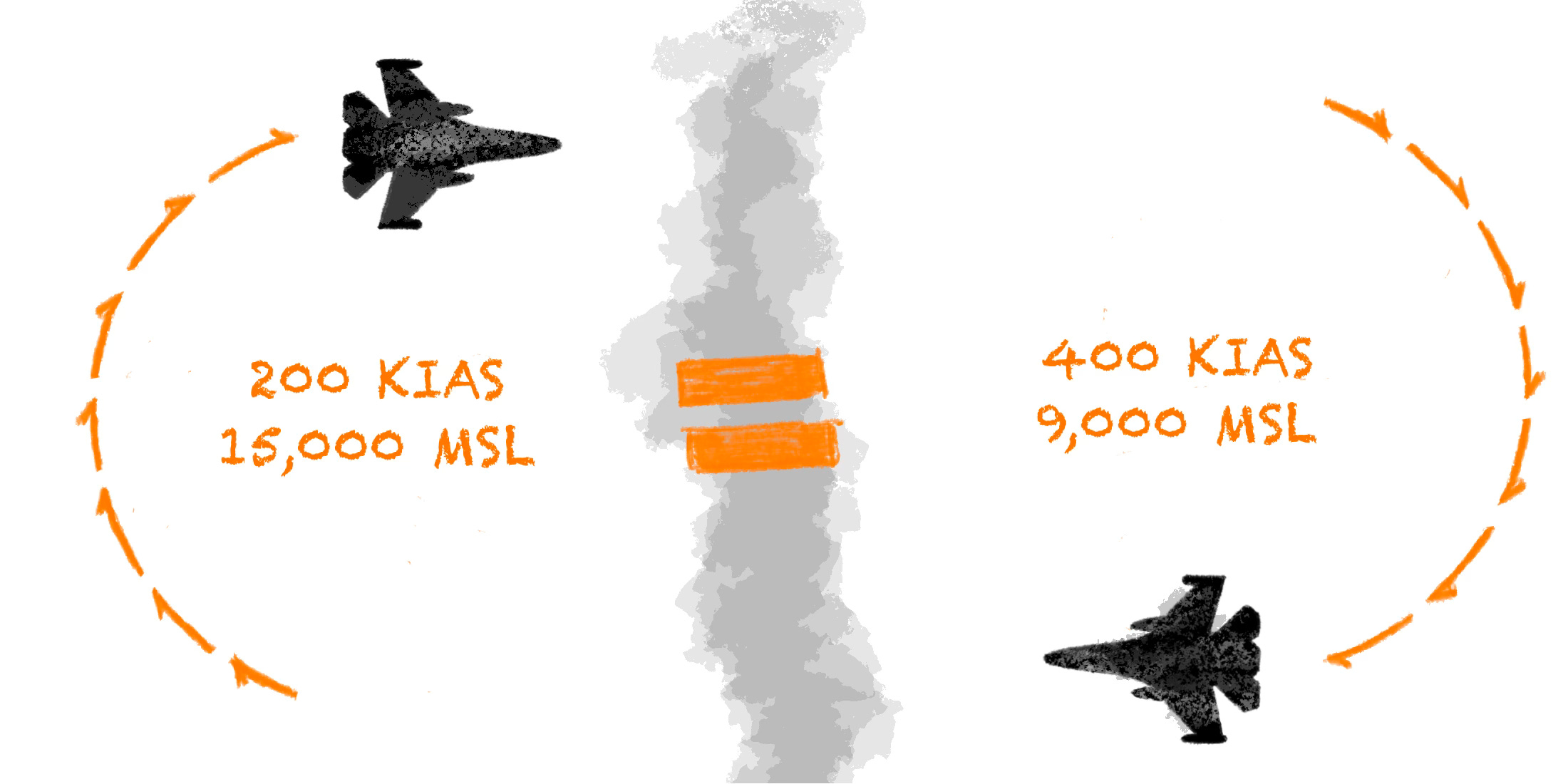
In the context of fighter jets, energy management also includes trading airspeed for angles—or G force. G’s are the fighter pilot’s secret weapon in taking or denying a shot opportunity.
Fight’s On: Rate vs Radius
Let’s get down to it: how do pilots dogfight? Well, after coming into the merge (two jets flying directly at each other—essentially the handshake before a wrestling match), each pilot will start developing their individual game plan to win.
Fighter jets can be designed to have a high rate of turn (deg/sec) or a small radius of turn (usually in thousands of feet). This is also known as two-circle or one-circle, respectively (kind of irrelevant why—many a student have broken their brains over this so don’t bother).
Rate, or two-circle, means using a jet’s superior thrust-to-weight ratio to turn around a circle quicker than the opponent and get a shot off. It involves maintaining a specific airspeed, known as the rate band, until right before a shot opportunity, when the pilot will pull back on the stick, increase G, and sacrifice the last bit of airspeed to momentarily maximize deg/sec for a shot.
Radius, or one-circle, means flying as slowly as possible to minimize the radius of the jet’s turn. This will maximize the jet’s nose authority (ability to position the nose for a shot) at the cost of “selling” all the jet’s energy down to low airspeeds.
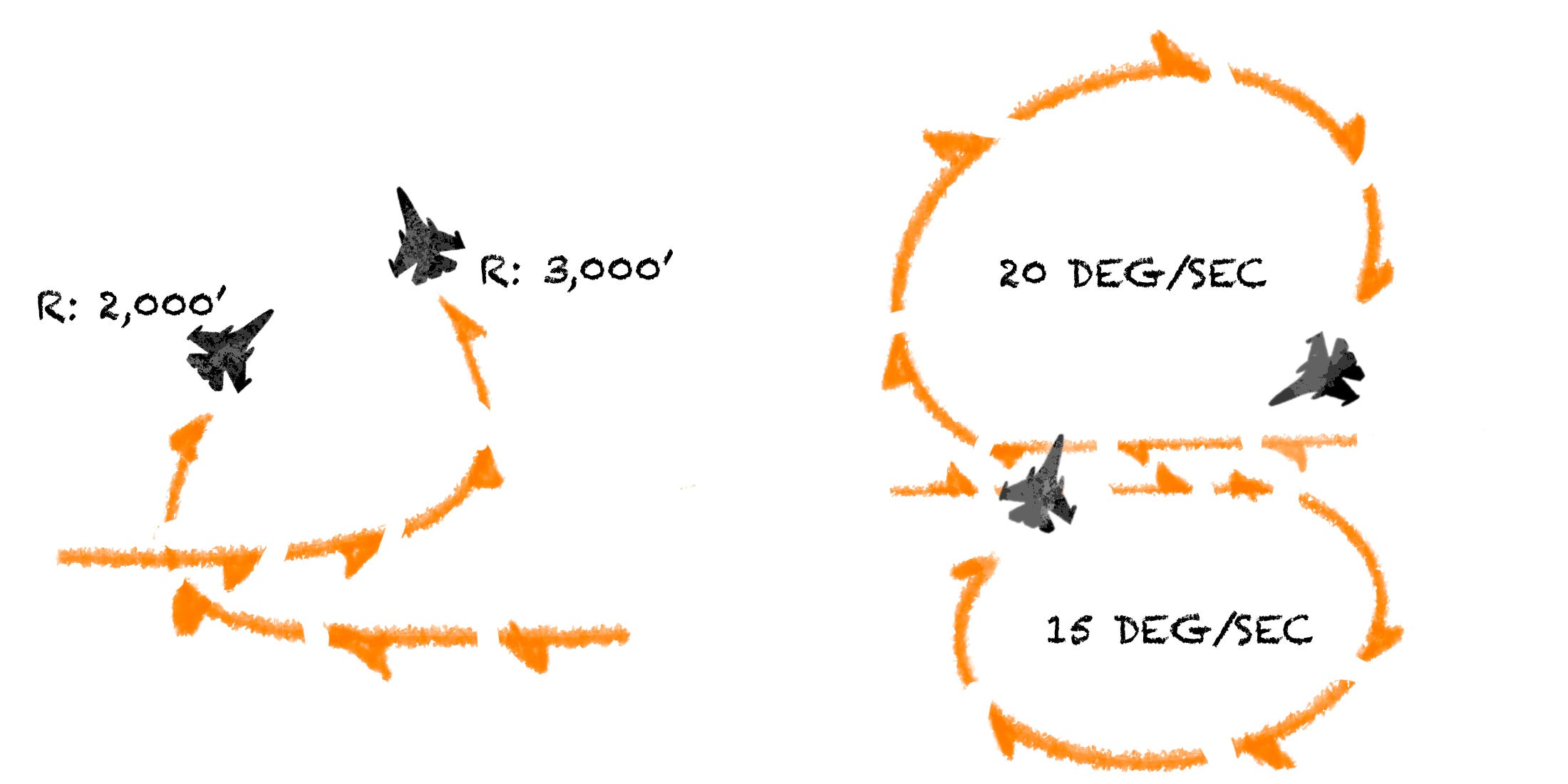
Depending on the situation, a dogfight may incorporate both rate and radius tactics. However, a pilot will maximize the odds of winning if they understand the strengths and weaknesses of both their jet and their opponent’s.
Who Comes Out on Top?
In the early half of the Vietnam War, the US Navy’s F-4 Phantom II was outmatched by the speedy and light MiG-17 and MiG-21. This can be attributed to many factors but most simply: the MiG’s were winning the one-circle fight.
After Top Gun was invented to fix these issues, the Navy stopped trying to turn with the MiG’s and instead shifted to a two-circle rate fight where the F-4’s incredible thrust-to-weight ratio would dominate.
The F-4 could sustain its speed during vertical maneuvers, while the MiG struggled with energy retention. After an energy-intensive defensive turn, the MiG often lacked the power to regain altitude, leaving it vulnerable.
Today’s fighter jets blur the lines as purely "rate" or "radius" fighters, though some lean more one way than the other.
The F-16 and the Eurofighter Typhoon, with their high thrust-to-weight ratios, exemplify rate fighting, prioritizing quick heading changes and sustained high-G turns.
The F-22 and F-35, along with the F-18 Super Hornet, tend towards radius fighting. Their advanced aerodynamics and powerful engines allow for high angles of attack and tight turns. However, these are generalizations, as factors like pilot skill and aircraft loadout significantly impact performance.
It’s the Archer, Not the Arrow
Countless times in aerial combat history, pilots have found ways to succeed in battles they have no business winning. The T-45, a trainer jet notorious for basically not being elite even moderately okay at anything, has had its time in the sun.
Understanding your own jet, your enemy’s jet, where you are in the timeline of the fight, and maybe even a bit of trickery, are all key factors pilots use in winning a dogfight.
And what would be an article on fighter jets without leaving you with some truly inspirational words from one of the best…
It’s not the plane, it’s the pilot. - Captain Pete “Maverick” Mitchell