

Surprise, the F-35 Program is Still a Disaster
Lightning II cash on fire...

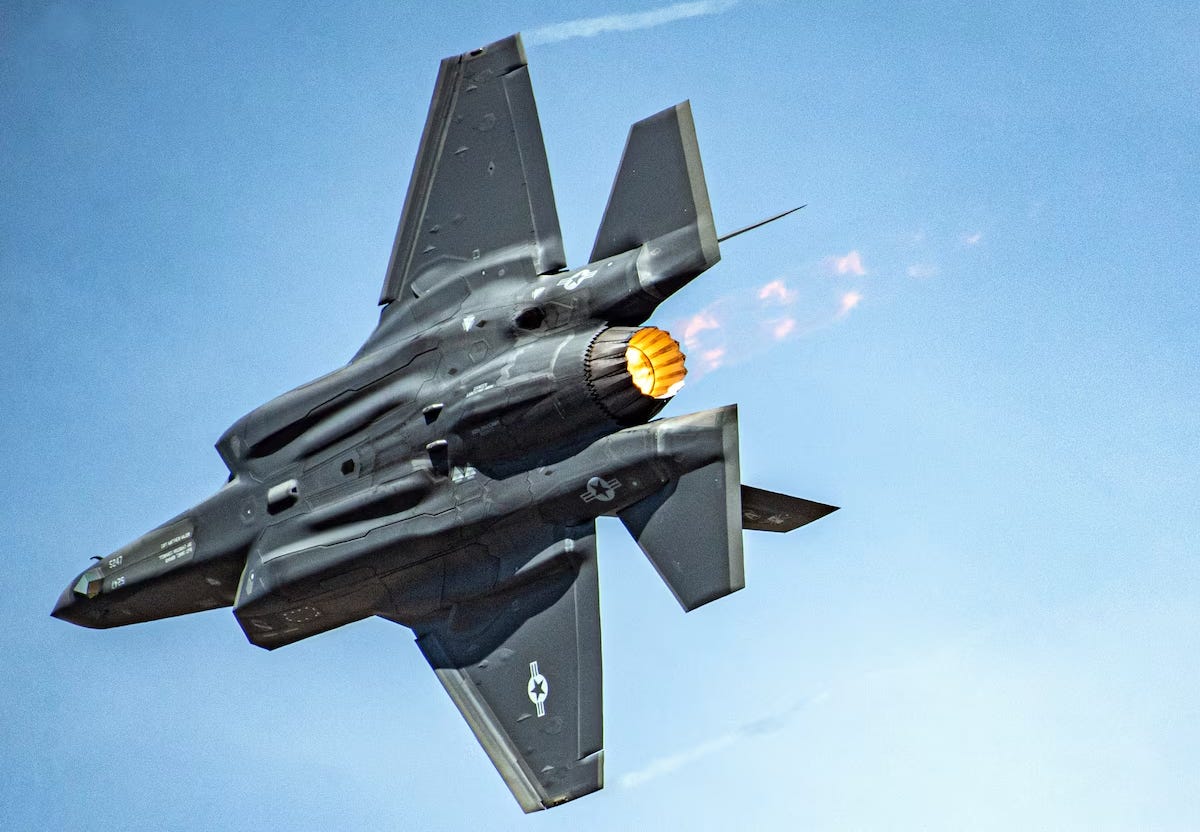
A Problematic Past
The F-35 has, to put it nicely, been having a rough go of it. Ironically, in 2001, it was originally sold to taxpayers as a “low-cost” replacement for the American jet fleet.
Fast-forward twenty-five years, and the cost per jet has doubled to $100 million each, with the lifetime sustainability budget ballooning from $1.1 to $2.1 trillion.
Procurement issues aside, the jet itself has suffered numerous PR flops in the last few years, including:
2025: an F-35A with a software glitch prefered to fly at 200 knots in “Ground Mode”, ignoring all pilot input and instead opting for violent, unrecoverable osicllations. After an airborne conference call with the engineers, this ended in ejection with the pilot walking away safely.
2023: an F-35B lost all displays due to a rainstorm (?) causing the pilot to eject. If this weren’t bad enough, the military couldn’t locate the jet due to its stealthiness. Actually, I guess that’s a good thing? Except when you publicly ask the locals to help locate it.
2022: an F-35B ejected during a vertical landing test in Texas due to a fuel tube failure caused by harmonic resonance.
What’s crazy is that this is just the most recent three. You can go down a rabbit hole of program failures since inception.
What Should Now Be on Your Radar
As if the above wasn’t bad enough, the latest issue and “solution” in the Lightning II program is delivering F-35 fighters without radars.
Starting in 2025, the newest lot of F-35s was planned to be delivered with the new APG-85, but due to delays, they don’t actually have the 85s available to be installed.
No problem, just deliver them with the old APG-81 radar (which is already being used in the fleet) and then swap them out later, right?
Wrong.
The newer 85 radar uses a completely different mounting system, making it impossible to just switch out radars as they are manufactured.
The solution? Ship the jet with no radar in the nose, but fill the space where it would be with “ballast” to maintain flight characteristics.
Translate to English: swithcy switchy $5 million radar with metal hunk of shit.
“Okay, but isn’t a radar like super important in a modern fighter jet? Therefore, these jets can’t actually be used operationally, right?”
Correct! And also incorrect!
The F-35 is capable of using onboard data from a wingman with functional systems so the current workaround is sharing that data using the F-35’s advanced communication system.
I expect that if there are ever any issues supplying engines for the modern fighter, the solution will be to connect it to a wingman via towing cable, since it still flies fine as a glider.
What are your thoughts? Will the Joint Strike Fighter program be worth it in the end, or will Lockheed Martin CEO, James Taiclet, be the richest retiree of all time?