

I Wore a Garmin Watch Every Flight for 3 Years: What Flying Fighter Jets Actually Does to Your Body
From flights in the T-45 to F-18: what 3 years of Garmin Fenix 7 Pro biometrics reveal about the physiological effect of the cockpit.

After 200 flight hours in Navy jet aircraft, my Garmin's HRV data knows things about my stress levels that my flight surgeon doesn't. And it's not nearly as polite about it.
Uh, yeah the plane is trying to kill me today and the weather’s not helping either but thanks, Garmin!
Every pilot knows the feeling of a good helmet fire. The stress from flying comes in many forms: engine failures, instrument approaches to minimums at night, or the haunting scream of a Radar Warning Receiver letting you know the Red Air has a weapons lock and you’re probably “gonna see that one again”. In naval aviation, a nice way to say you just blew that flight.
As pilots, we pride ourselves on sounding cool on the radios. Flat, nonchalant, and unbothered with a heart rate of 190 bpm, knowing full well you just missed a crucial instruction from ATC and can expect a phone number to call when you land.
So, although we’ve mastered the ‘pilot voice’ on the outside, how does the body actually respond internally to the chaos of flying?
After wearing my Garmin watch for every single flight I’ve had in a Navy jet aircraft, I finally have an answer.
What Flying Does to Your Body
In my opinion, the three factors affecting stress levels while flying are: physiological (what’s happening to your body), cognitive (what’s happening to your mind), and environmental (what’s happening in the environment around you).
Physiological: think G forces, lower oxygen saturation, fatigue, etc.
Pilots constantly experience changes in G-forces to their bodies as they climb, descend, or dogfight. Humans on Earth experience 1 G. Highly trained fighter pilots can experience up to +9 Gs, but even mild maneuvering in a light sport aircraft can create real physiological discomfort.
Another thing that happens when climbing to higher altitudes is air gets thinner and, consequently, blood oxygen saturation decreases. Hypoxia is a physiological condition all pilots are educated about and which usually occurs when oxygen saturation levels fall below 90%. However, even a decrease below 95% can have a significant impact on cognitive performance. For my Marines needing their annual flight medical refresher: go high up in sky make pilot brain dumb, can go crashy crashy.
Cognitive: these would be the mental loads the pilot needs to juggle during routine as well as abnormal flight conditions. Communicating with ATC, communicating within the flight crew, monitoring engine temperatures, monitoring weather at the destination, the list goes on forever. Combine all these tasks at once and quickly the job of a pilot can become quite ‘task-saturating’. It’s just like walking and chewing bubblegum at the same time… but at 30,000 feet with people’s lives at stake. There’s an old saying along the lines of “the plane has a magic button in it and when you sit on it, you instantly lose 50% of your brain power.”
Some instructors would definitely argue that, for me, that number is probably much higher.
Environmental: heat, noise, weather, and daylight all have their vote as well when it comes to impacting performance.
Despite what you’ve heard about Kingsville, Texas, it’s not that similar to the Amalfi Coast. It actually gets incredibly hot in the summers—well above 100 F with humidity. Just walking to the jet your heart rate can already be in Zone 2. Combine this with some unforecasted weather rolling in and a fuel leak in the ol’ Goshawk and you’re on a bingo profile to Austin while your Garmin congratulates you on the ‘Productive’ Threshold session.
Individually, any number of these factors can have a major impact on whether you have a nice, uneventful flight or if “you’re gonna have to see that one again”. Combine all three and you can quickly go from helmet fire to helmet climate change.
How I’m Measuring In-Flight Stress
The Garmin Fenix tracks stress continuously using Heart Rate Variability (HRV), which is the variation in time between each heartbeat. Counterintuitively, a less regular heartbeat is actually a good sign. Higher HRV means your nervous system is relaxed and adaptable. Lower HRV means your body is under load, whether that’s physical, mental, or emotional.
Garmin converts this into a simple 0–100 stress score. Under 25 is resting. 26–50 is low stress. 51–75 is medium. Above 75 is high stress.
The Data
My First Flight in a Navy Jet
Flight: first flight in the T-45, the most powerful aircraft I had flown yet
Solo: no
Preflight nervousness: extremely high
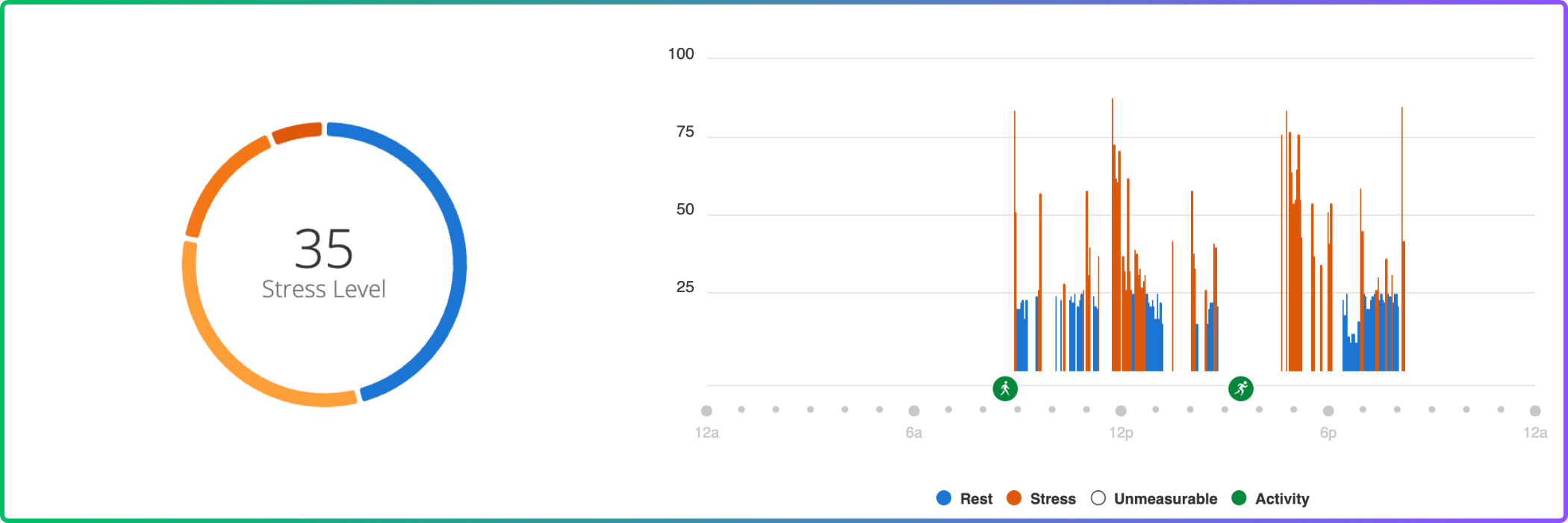
Analysis: Honestly, kind of what I expected. The first flight was a lot of show and tell. When I went through, you actually sat in the back while the instructor did the taxiing, comms, and basic admin stuff. You shoot an instrument approach under the hood as the hardest part of the flight but at that point in the syllabus, you’ve done over thirty sims with much harder approaches.
Okay… what about some early forms flying? First time being that close to another jet, lots of new comms, and flying out of Corpus Christi International versus home field.
Baby Forms Double
Flight: two basic formation flights in one day
Solo: yes
Preflight nervousness: high
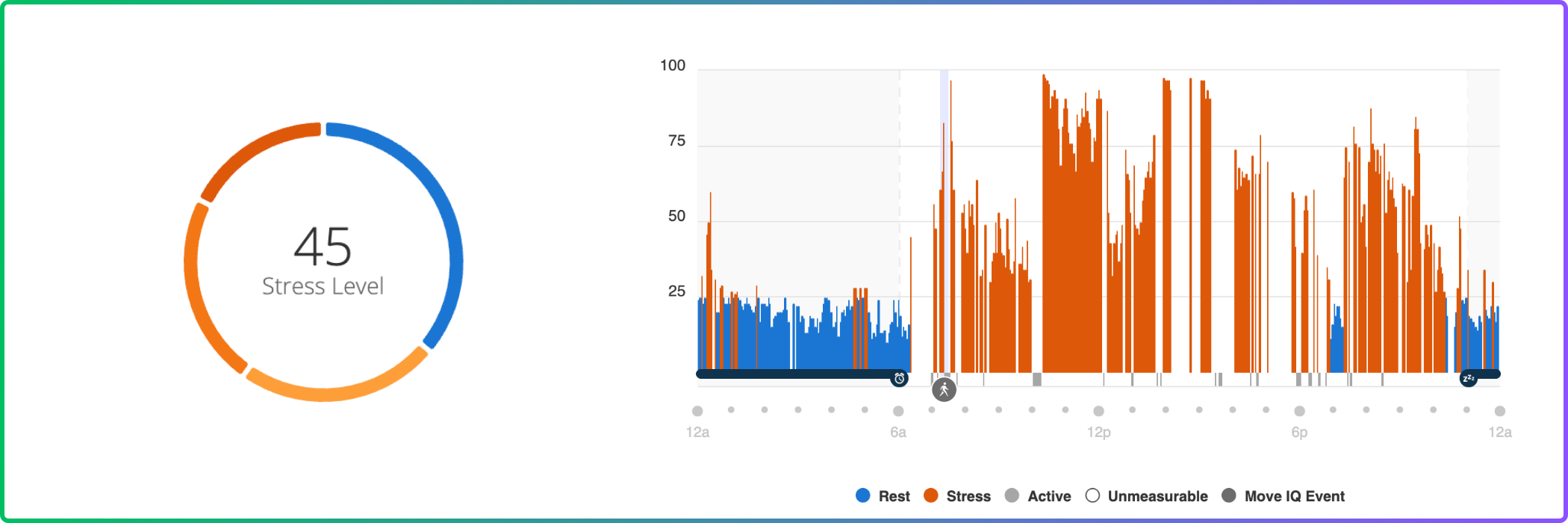
Analysis: That’s more like it. I remember this flight well: I was struggling in this stage with basic join mechanics and it took me a while to get to the solo (read: I saw some flights again). So these solo flights were highly anticipated and, even though I knew I was ready, flying two flights in one day in Texas heat is tough, and I really wanted to do well. The second spike of orange at night was definitely some alcohol-induced celebrating, which I guess Garmin calls stress. Nark.
That forms double was about a quarter through the syllabus and clearly I wasn’t yet showing any adaptation. A little more flight time should help calm me down and make me more comfortable in the jet. Not quite… Hello, Darkness, my old friend.
Night Forms Double-Header
Flight: back-to-back night flights, two on the first night and one on the second
Solo: no for the first two, yes for the second one
Preflight nervousness: not for the first one, yes for every one afterwards
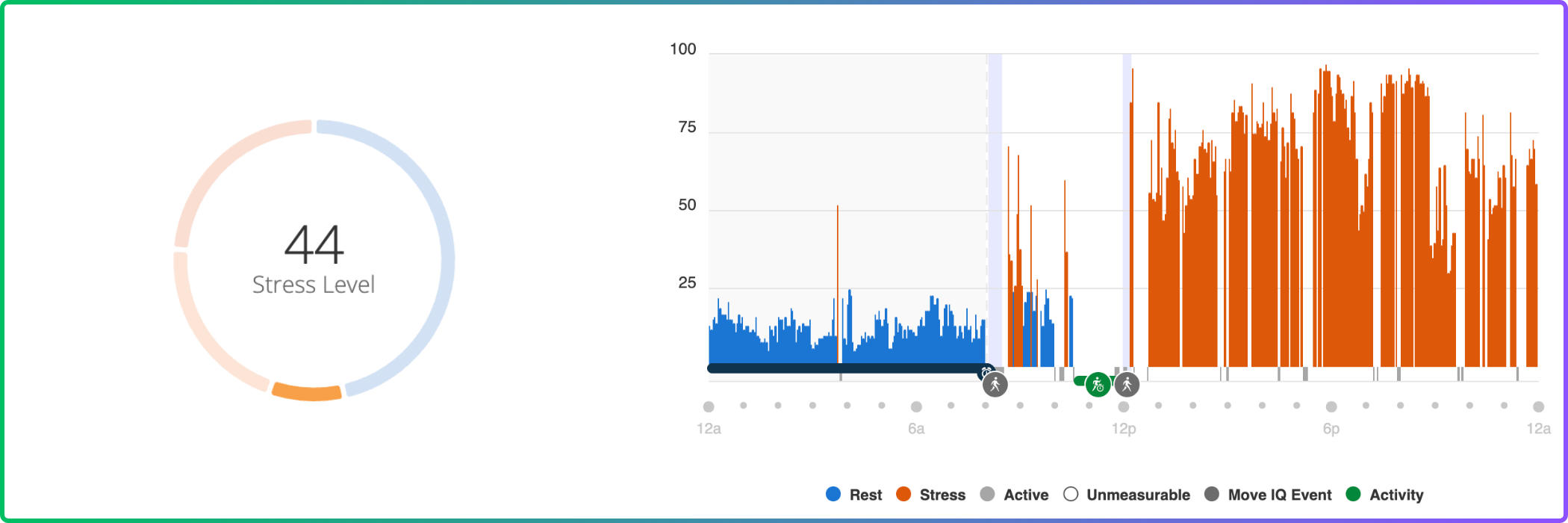
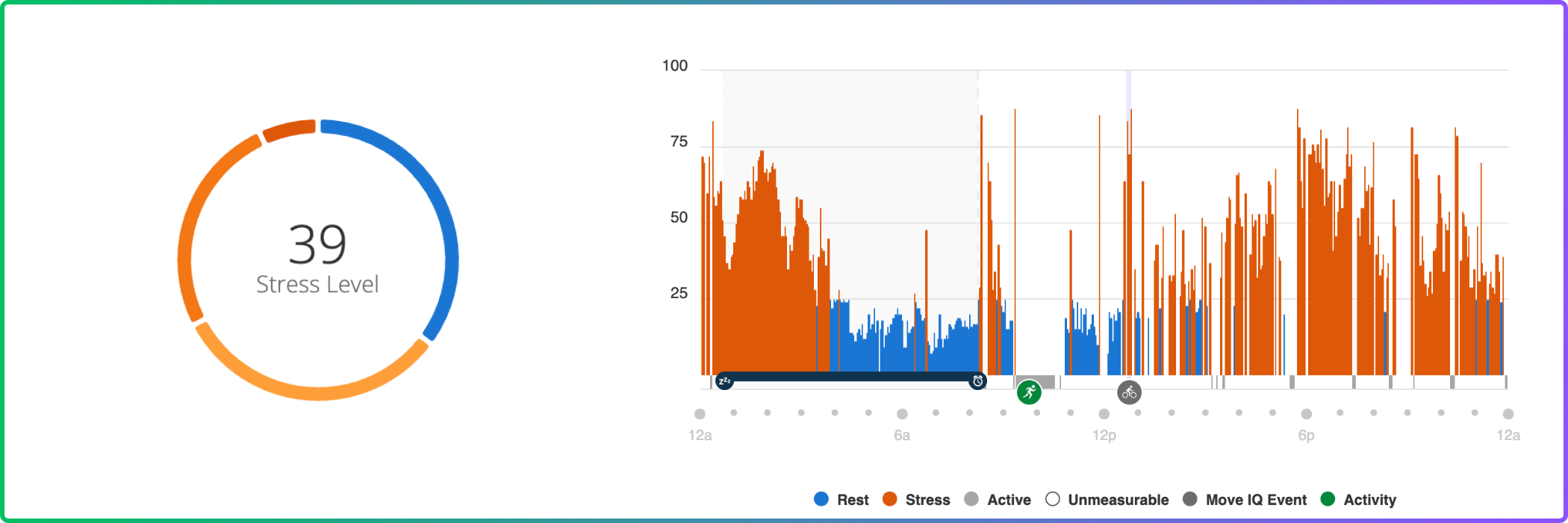
Analysis: Yeah this was terrifying. Terrible weather, no illumination, recovering as a section and not being able to see my lead? Helmet climate change 100%. What’s interesting about the data is that I never recovered from the first night of two flights into the second night of just a single sortie. Clearly there’s more to adapting to high-performance flight than just how your body reacts in the moment.
Cross-Country “Bro”-lo
Flight: cross-country instrument flight with one of the SERGRADs (students who wing and then spend a year as T-45 IPs before continuing on to fly their fleet aircraft)
Solo: no… bro-lo!
Preflight nervousness: zero
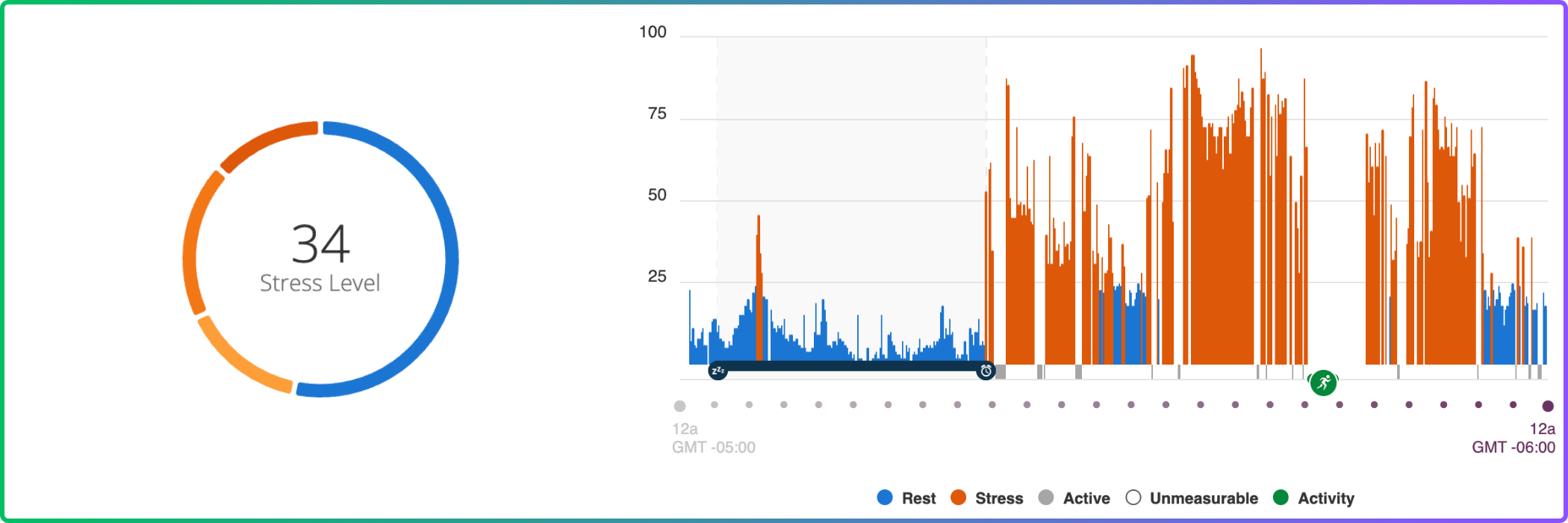
Analysis: Overall stress score was lower but there was definitely still some orange chunks of high-stress data. The jury’s not out yet, but I suspect that while the body may never truly adapt to the adrenaline rush of a fighter jet, the stress you experience in pre- and post-flight and your body’s ability to recover is what you do get better at.
My Toughest Dogfight
Flight: Basic Fighter Maneuvers with one of the hardest instructors in Kingsville
Solo: NOPE—absolute hammer in the backseat
Preflight nervousness: high
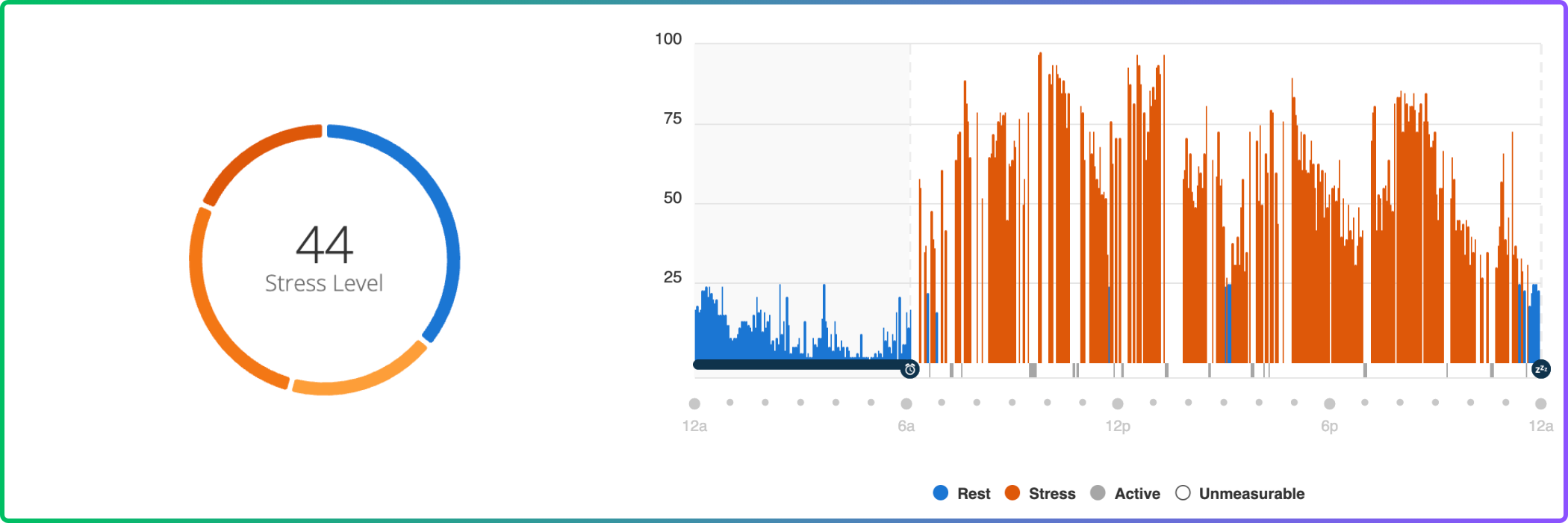
Analysis: Definitely need to recalibrate to this level of intensity. Working hard to maintain an offensive position in the fight, all while getting some… constructive feedback from the instructor behind me at high decibles? STRESS.
My Last T-45 Flight
Flight: Fighter intercepts against one of my favorite instructors
Solo: yes
Preflight nervousness: high
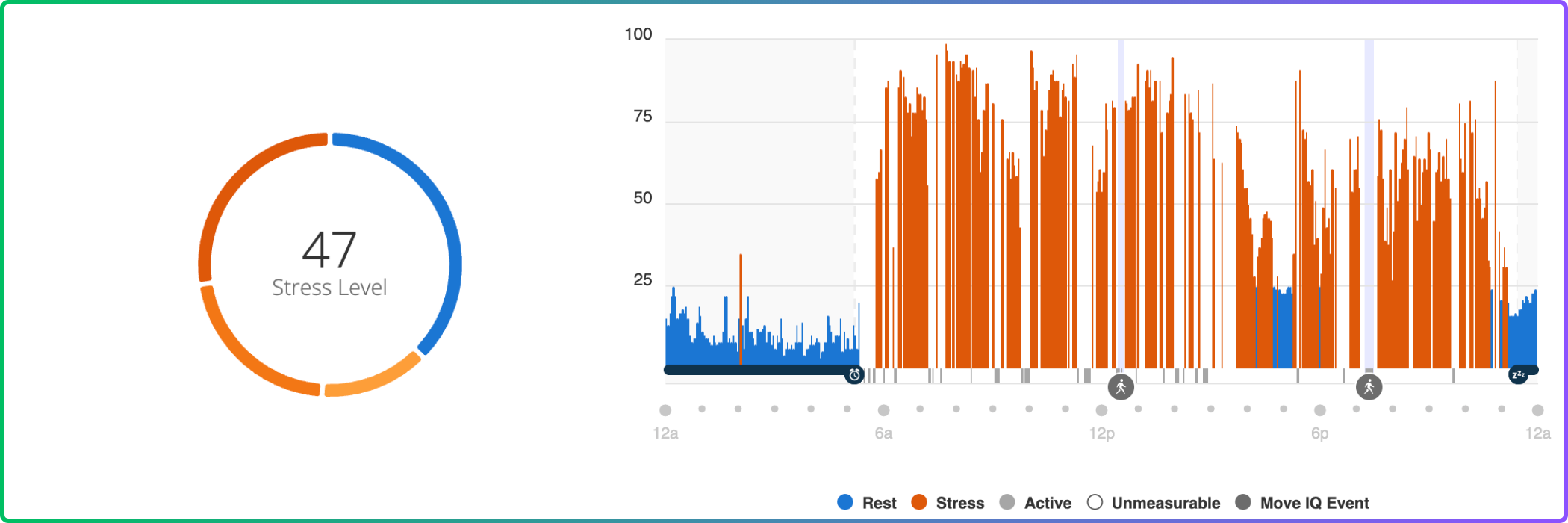
Analysis: A flight I was definitely looking forward to but not in a nervous way. Regardless, all that excitement seems to take its toll on the body. It could have been any number of things: the high Gs, the desire not to kill myself or the instructor, bringing it in for the break way faster than my skill level to show off to my friends, etc… A high-stress day that definitely included Stress Beers later that evening.
This Garmin data provides a snapshot of the Navy Advanced Jet Training pipeline. The metrics suggest a clear correlation: as piloting proficiency increases, physiological resilience follows, allowing the body to sustain higher intensities for longer periods. However, the curriculum is intentionally relentless; the moment you achieve competence in one phase, you are thrust into a new, demanding learning curve.
But what happens when you introduce the T-45-adapted-human to a new jet that is twice as fast, can drop laser-guided bombs, and has almost 10 times more thrust?
Actually, the data surprised me.
My First Flights In An F-18
Flight: first-ever flight in the F-18 and first solo a couple days later
Solo: no for the first, yes for the second
Preflight nervousness: low
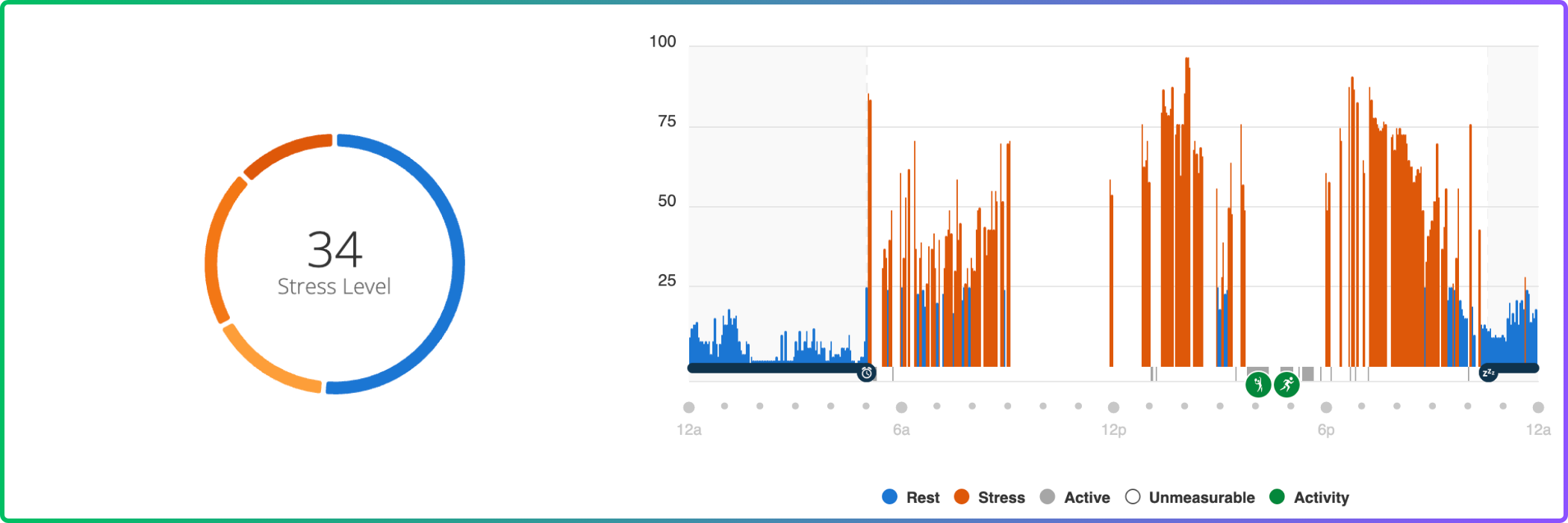
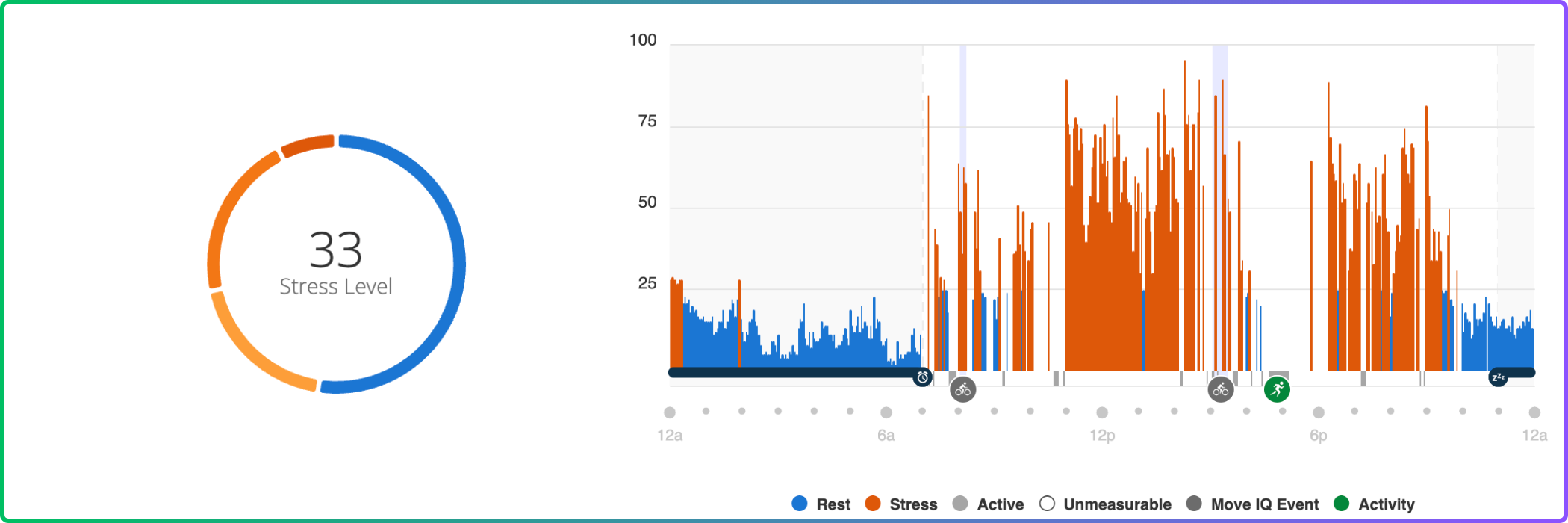
Analysis: stress levels way lower. This could definitely be partly attributable to the weather in Virginia Beach in the fall being about 30 degrees cooler than when I had my last T-45 flight in Kingsville in the summer. I think it’s also true, however, that my body is getting better at adapting to stress in the jet and being familiar with the nerves of “firsts,” so the effect is no longer as dramatic. And ultimately, the F-18 is a fantastic jet, with lots of computing tech that makes the simple tasks of flying it much easier and safer than the unwieldy beast of the Goshawk.
Which makes sense. The Goshawk is a trainer that demands your attention. It forces you to respect spool-up lag and the art of manual trimming. But the F-18? The Rhino wants you to be a tactician. It makes the act of flying as seamless as possible, ensuring that when things get heavy, your brain power is spent on the mission, not the airframe.
The Verdict
The data won’t surprise any pilot reading this. We already knew the jet was trying to kill us; it’s nice to finally have the charts to prove it.
What it does confirm is something every instructor tries to tell you and you never fully believe until you feel it yourself: you never get less stressed, you just get better at managing it. The Goshawk built the foundation. The Rhino is where you find out what you built it for.
The T-45 data told a story of adaptation. The early F-18 data suggests that adaptation carried over. But the fleet is a different animal: deployments, night carrier operations, real-world threat environments. The stressors don’t get smaller, they get more consequential.
I’ll keep wearing the watch. At some point the data will stop being surprising and I’ll just accept the fact that I suck and no amount of autopilot will make my landings any better.
Let me know what you think about all this. Should pilots even wear fitness trackers?
What if in the future, the FAA made it mandatory for pilots to track their stress and recovery to determine if they’re safe to fly that day? 👀
Your Support Makes My Heart Race
Corny? Yes. True? …Maybe?
I write everything for free in the hopes that it will inspire and educate on what it’s like to fly planes in the world’s greatest Navy and to spread the joys of aviation in general.
If you enjoyed this article, you can show your support by checking out my store on Etsy where I sell really cool aviation-themed streetwear clothing. It’s all designed by me, a real-life, very-average fighter pilot.

Another way you can show your love for my writing and for your body ❤️? (Barf)
Get yourself a Garmin. I love mine and have been wearing some variation for years. They’re fantastic watches worn by tons of pilots and fitness enthusiasts. I’m not sponsored but I do make a small commission, at no cost to you, from any sales from links I direct to Amazon. Check them out, they’re great.
