How Long is Navy OCS?
A week-by-week timeline breakdown for candidates who want to feel prepared, and families who want to understand what's coming

Navy Officer Candidate School
Navy OCS is 13 weeks, located in the beautiful Newport, Rhode Island.
But if you’re searching for this question, you already know the number isn’t all that you’re getting yourself into.
You want to know what the process is from turning any civilian off the street into an Ensign in the United States Navy.
Turning a lump of coal into a diamond takes intense energy in the form of heat, temperature, and time, and the OCS process from Indoc Candidate to CandiO can often feel similar.
Enough with the awful metaphors, this isn’t a PLA recruitment video. Let’s break it down.
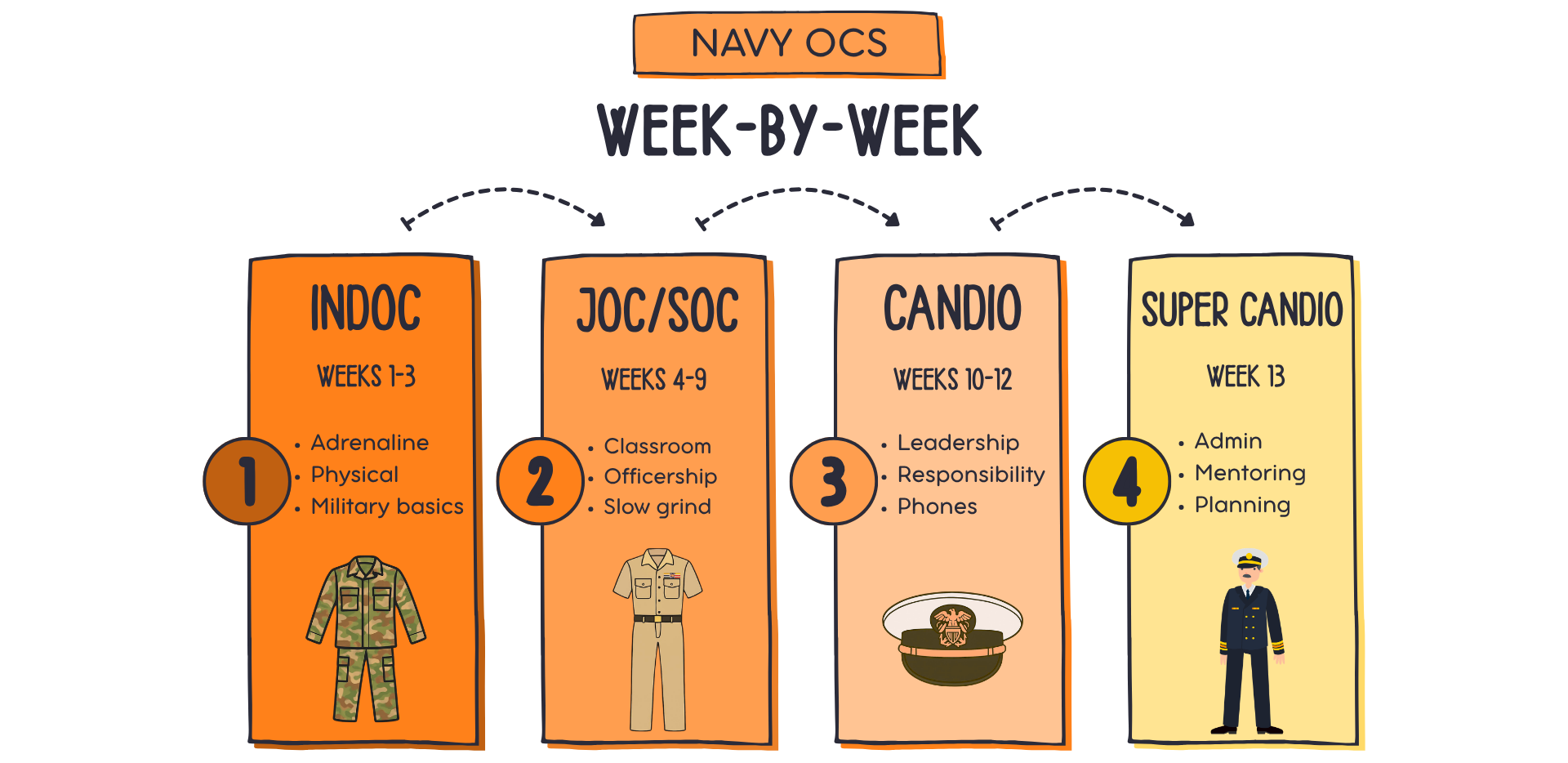
The Big Picture: 4 Phases, 13 Weeks
Most articles say OCS has three phases: Indoc, JOC/SOC, and CandiO. Each one lasts three weeks for a total of twelve weeks.
While this is technically true, the last and best phase, Super CandiO, is tacked on at the end for out-processing and administrative paperwork. A bit of a victory lap, if you will. Call it thirteen.
Additionally, life, with its ups and downs, continues to roll on while at OCS. You might get injured, fail an event, or experience any number of unforeseen hardships that may increase your timeline. 13 weeks is the minimum and usual time people take to graduate OCS, but this can be extended by spending time in H-Company (holding).
I wrote a full breakdown of each phase if you want to go deeper, which will be linked in each subsection below.
Weeks 1–3: Indoctrination
This is the phase everyone fears. It’s your indoctrination into the military culture and that’s done with physical force. Being ballistic (yelling), PT-ing, and moving with a purpose are all new experiences you will be introduced to.
I enjoyed this. From ‘First Friday’ to ‘The Tour of Training Country’ to ‘RLP’, this is by far the most physical and shocking phase. You get to wear a US military uniform with your name on it for the first time ever and it really feels like you’ve made a massive step. Of course there are ups and downs, but overall, it’s exciting.
For loved ones: this can be a really tough phase for you at home. During these three weeks, they likely won’t be able to contact you at all via phone. You can expect an “I arrived safely” call when they first get there but then likely radio silence until the end of the phase and they’ve succesfully passed RLP. Mail, on the other hand, is always authorized. It’s distrubuted daily and can be a lifesaver—so write often!
👉 Read my full Indoc breakdown here
Weeks 4–9: JOC → SOC
This is the longest stretch, but it has a turning point built into the middle of it. A made-up fake turning point designated only by a change in uniform, but a turning point nonetheless.
Week 4 is the start of Junior Officer Candidate (JOC) phase and marks the beginning of becoming a scholar. A painfully boring torture experience when administered at OCS.
Week 7, another identity shift: you become a Senior Officer Candidate (SOC). More classroom pain and boredom, except now the torture is amplified by forcing the absorption of knowledge first through a set of khaki uniforms and then into your soul.
By far the worst phase, in hindsight. I longed for fresh air or the physical challenge of more than 1,000 steps in a day. Contraband caffeine pills were more popular than Creed in the 2000s. Hold me now.
For loved ones: You should now have the ability to talk on the phone with you Officer Candidate every Sunday. The slots are pre-scheduled usually the day before and aren’t very long. Hearing a familiar voice on the line is incredibly heartwarming.
👉 Read my full JOC/SOC breakdown here
Weeks 10–12: CandiO Phase
This is the phase that everyone dreams of as you climb the miserable ranks in Newport. You go from being led to leading (or something that resembles it) and your hat gets a nice upgrade. Life here is pretty great.
I had waited a long time to be able to walk around without marching or waiting for everyone to get their food so we could start eating. Being a PT DIV-O is still a highlight of my career. I just can’t quite remember doing all that much…
For loved ones: By now your near-Ensign should have their cell phone with full access to texting, calling, and emailing depending on the time of day and liberty status. Rejoice!
👉 Read my full CandiO phase breakdown here
Week 13: Out-processing and Commissioning
Nobody writes about this week; it deserves its own section.
The fleet training briefs happen here. The mentorship sessions. The graduation prep. Candidates are no longer running the squadron as they’ve passed the banner on to the next group to follow. You’re responsibility-free and, if lucky, get to enjoy some of Newport’s highlights while on liberty.
A strange and rapid deceleration in intensity from weeks prior, this victory lap of MWR pizza and planning your first purchase with your O1 pay might be the reason you joined the Navy after all.
For loved ones: during this time you’ll be in constant communication with your sailor as you coordinate and arrange the graduation ahead. By now you should have probably booked a place to stay and maybe even made reservations. Also, start preparing now for all the weird things your likely-unrecognizeable Ensign might say when you reunite. It’s all part of the un-brainwashing.
How to Prepare for Those 13 Weeks
Physically: you need to be able to run, do push-ups, and planks. It’s that simple to train for.
Mentally: you need to be able to eat horrible food, not sleep that great, and then not fall asleep during some of the most boring moments of your life but also be able to burst into action during some of the most exciting moments as well. Not easy to train for.
What to pack: The gear list matters more than most people expect. I put together a full packing list with everything I’d bring again and everything I’d leave at home.
👉 See the full OCS packing list (for everyone) and for females specifically
👉 See the physical preparedness guide and workouts to expect at OCS
For the Families and Partners Waiting at Home
This section is for you specifically.
Here’s the communication timeline:
- Check-in day: One 5-minute scripted call.
- Weeks 1–3 (Indoc): No calls. Letters only.
- Week 4 onward: 10-minute weekend slots. Sign-up sheet posted just days prior.
What you can do right now: write letters, build a care package, stay busy.
👉 See the OCS CandiO Box / care package guide
The Bottom Line
13 weeks sounds long. It goes fast.
An old saying you’ll often hear is “the days are long but the weeks are short” and it couldn’t be more true. The friends and memories last a lifetime and when my OCS buddies and I get together, we still cry from laughter reliving some of those days.
Grit through it, but don’t forget also to enjoy it.
Your Support
I write everything for free in the hopes that it will inspire and educate on what it’s like to fly planes in the world’s greatest Navy and to spread the joys of aviation in general. I don't run ads and I don't put anything behind a paywall.
If you enjoyed this article, you can show your support by checking out my store on Etsy, where I sell really cool aviation-themed streetwear clothing. It’s all designed by me, a real-life, very-average fighter pilot.

Also, if you're interested in Whoop and how it can help in your fitness journey, you can try a one month free trial. I'm not sponsored but it does help me to continue to write on topics and tech that help pilots and fitness enthusiasts.

Or, if you think you'd prefer to give Bevel Health (my favorite app to use with my Garmin Fenix) a go, you can also try one month free.
And finally, if you are interested in the best fitness watch on the planet, worn by thousands of pilots worldwide, check out Garmin. I'm not sponsored, they just make one hell of a product. If you shop through my Amazon affiliate link, I make a small commission at no cost to you. It's not quite enough to pay for weekend gas in the Cessna, but it does help cover a couple of beers. Thank you!

Let me know if you decide to try any of them out and what your thoughts are! I love talking tech.
-Will!